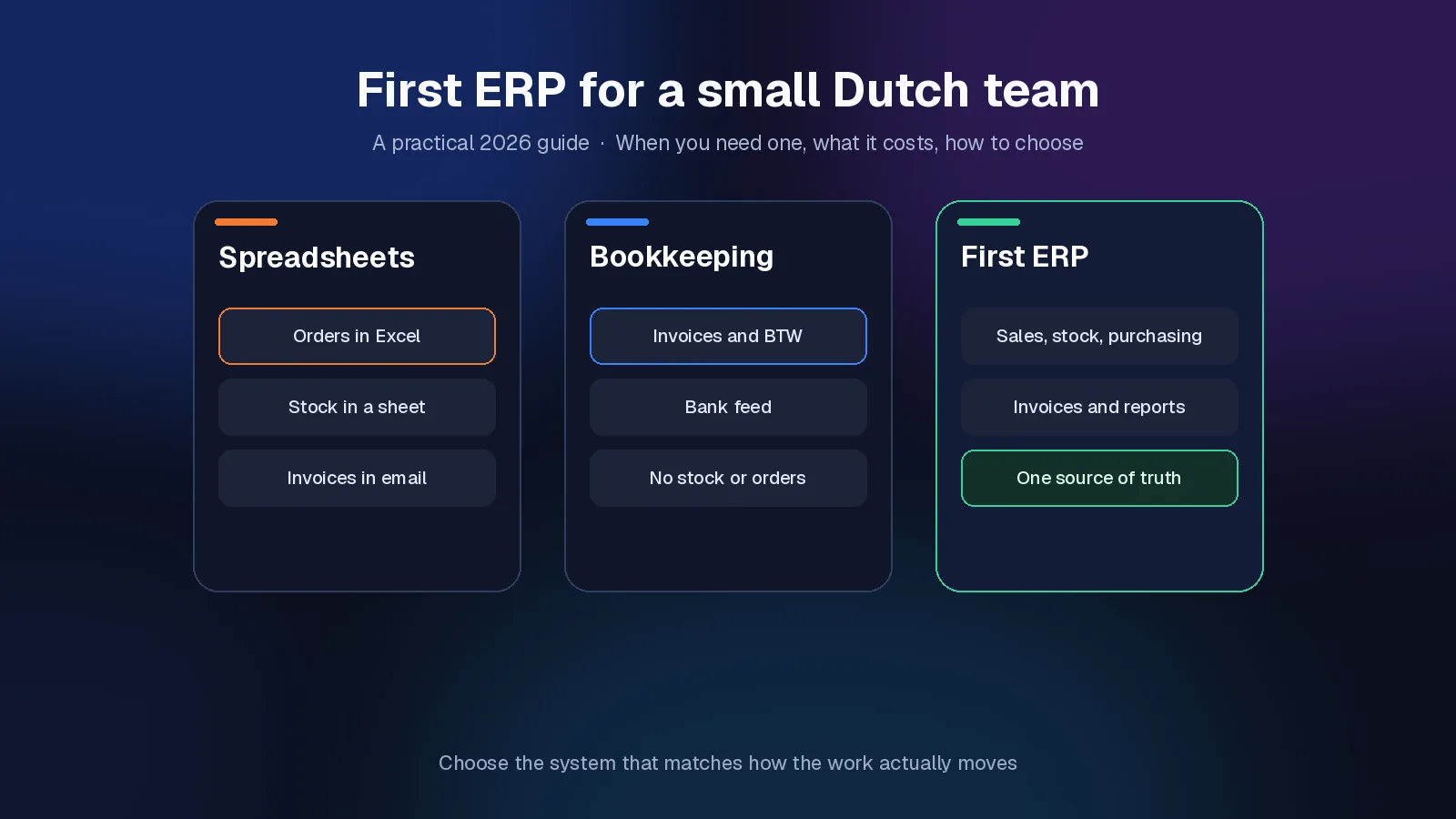
Short answer: a first ERP is one system for sales orders, stock, purchasing and invoicing, so those numbers stop living in separate spreadsheets. You need one when several people update orders or stock every week and nobody is sure which figure is right. If you only send invoices and file BTW, bookkeeping is enough; if you only need a sales pipeline, start with a CRM. Licences vary: Exact Online Handel starts at €269 per month excl. BTW for one user, Odoo is billed per user, and ERPNext has no per-user licence. My ERPNext work starts with a Process Discovery from €595 excl. BTW, then implementation from €3,950, usually over 4–8 weeks.
This guide is for owners and operations leads of 5–20 person teams in the Netherlands and the wider EU who have outgrown a spreadsheet and the accountant’s package. It covers what a first ERP is, how to tell whether you need one, how Exact, Odoo and ERPNext compare on public 2026 prices, and the GDPR and e-invoicing points to check before you sign. Licence figures were checked on 16 November 2026; sources are at the end.
What a first ERP is — and what it is not
ERP stands for enterprise resource planning, an unhelpful name for a small company. In practice it means this: when a customer order is entered, stock is reserved, a purchase can be raised if something is missing, delivery is recorded, and the invoice uses the same numbers. Reports then come from that chain, not from a Friday-evening copy-paste into Excel.
Three other tools are often confused with it:
- Bookkeeping software records invoices, bank transactions and BTW. It is essential, and for many zzp’ers and small service firms it is all they need. It does not run stock levels, purchase orders or a warehouse.
- A CRM holds leads, deals and follow-up. It answers “who are we talking to and what happens next?” It does not, on its own, tell you whether you can ship tomorrow.
- Spreadsheets are fine while one person owns them. They break when two people edit stock, a third raises a purchase in email, and the invoice is typed again from memory.
A first ERP for a small team is narrower than a corporate project. The modules that usually matter are customers and suppliers, sales orders, purchase orders, stock, invoicing and a handful of reports. HR, manufacturing planning and multi-company work can wait. If you configure everything in month one, the team will go back to the spreadsheet. A typical fit is a trading or wholesale business, a workshop that also sells parts, or a product company that has started to trip over stock counts. A pure services firm with no inventory almost always needs a CRM and solid bookkeeping first, not an ERP.
Signs you need a first ERP
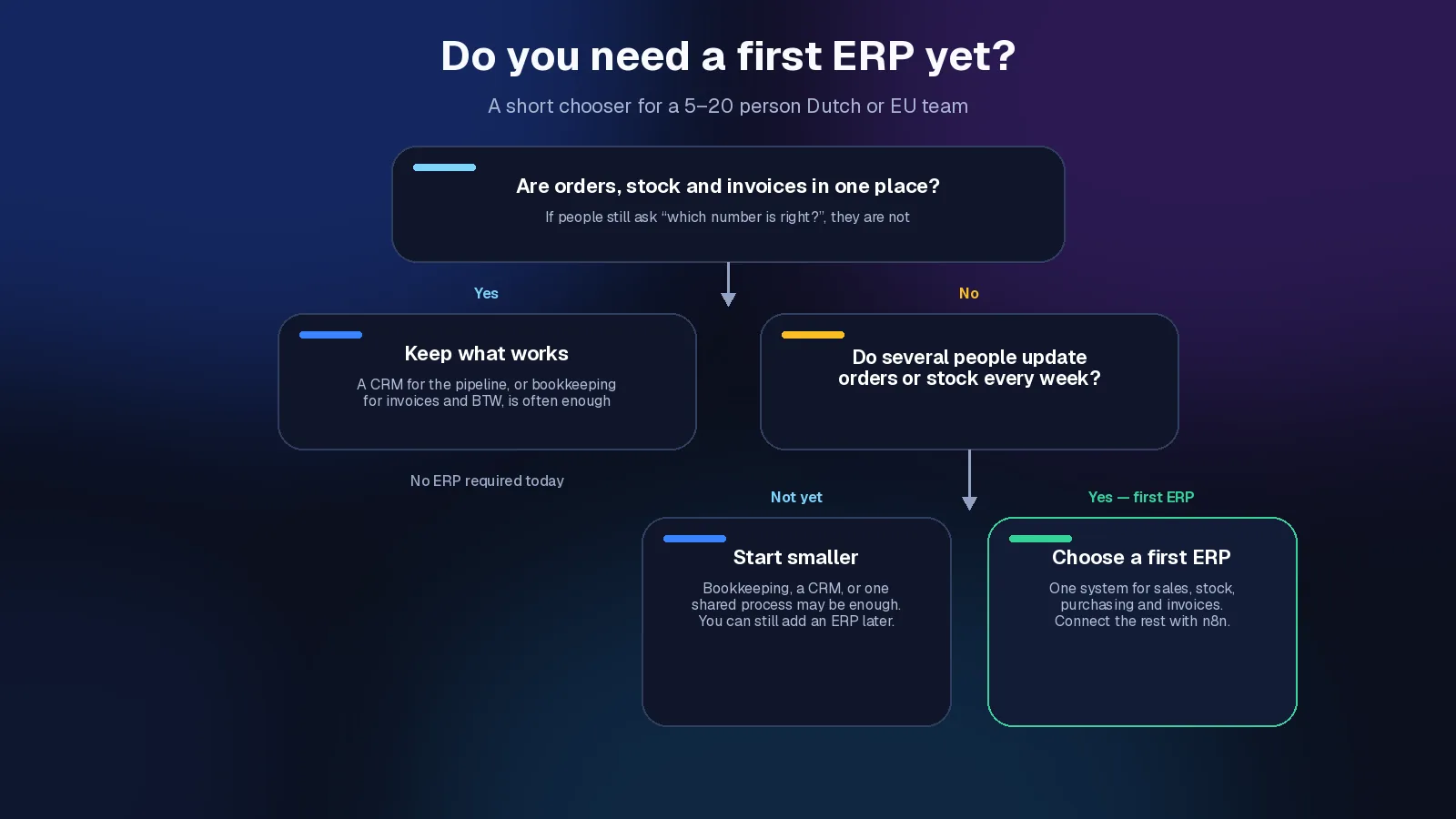
Use this as a checklist, not a score that must hit every line. Two or three of these, happening every week, are usually enough to justify a closer look:
- Stock in the sheet does not match the shelf. Someone is already doing a weekly recount to fix it, and sales still promise goods that are not there.
- The same order is typed more than once — into a quote, a delivery note, a purchase email and an invoice — and the quantities sometimes drift.
- Purchasing is reactive. You find out you are short only when a customer is waiting, then someone places a rush order by phone or WhatsApp.
- Month-end is a reconciliation project. The bookkeeper asks which of three files is right, and it takes days to produce a number you trust.
- Handover depends on one person. If that colleague is ill, nobody else can see open orders or what was promised, and a new hire cannot be trained on “look at this sheet, then that inbox.”
If the only problem is leads in inboxes, fix the CRM first. If it is invoices and BTW, improve the bookkeeping. An ERP is the right next step when the chain — order, stock, purchase, invoice — is what keeps breaking.
What to implement first
The implementations that stall try to rebuild the whole company in software. The ones that finish start with a single path: sales order to delivery to invoice, or purchase order to goods in to stock. Everything else stays in the tools you already use until that path is reliable. Follow one recent job that went wrong on paper: who touched it, which file they used, and where the number changed. That map also tells you what not to migrate. Old quotes, unused product variants and dead customer rows can stay in an archive. A first ERP should go live with clean, current records.
Options for a small team in the Netherlands
There is no single “best ERP for SMEs.” There is a fit for how you work, who will look after the system, and whether you want to pay per user or for hosting. These are the options I am asked to compare most often. The figures below were checked on 16 November 2026; sources are linked at the end and in the table.
Stay on bookkeeping, for now
If you mainly send invoices, import the bank and file BTW, a Dutch bookkeeping package is the right tool. Moneybird and Exact Online Boekhouden both publish starting prices in that range (see the table). Neither is a warehouse system. Do not buy an ERP to do a bookkeeper’s job.
Exact Online Handel
For Dutch trading companies, this is the familiar local ERP: purchasing, sales, stock and bookkeeping in one subscription. Exact’s Handel page starts at €269 per month excl. BTW for Essentials, with one user and two administraties included; Plus, Professional and Premium step up from there, and extra users are charged on top (see the table). The Benelux product page states that all Handel prices are excl. BTW. Essentials already covers purchase, sales, stock and article prices; higher plans add multiple warehouses, batch numbers and MRP. This is often the path of least resistance if your accountant already lives in Exact.
Odoo
Odoo sells all of its apps for a single per-user fee, on Standard or Custom plans, with a free one-app option. The official pricing page localises the currency. From this environment on 16 November 2026 it displayed US dollars (Standard US$24.90 per user per month as the first-year annual figure, US$31.10 regular annual, US$38.90 billed monthly; Custom US$49.00 / US$61.00 / US$76.20; Light user US$8.90). I will not convert those dollars into euros myself. A European partner, KAPEO, published a November 2026 reading of odoo.com in euros: Standard €19.90 per user per month in the first year with annual billing, then €24.90; Custom €35.90, then €44.90. KAPEO notes that Odoo’s own page is always authoritative, and that the lower price applies for 12 months to the users you first order. Check the live page in your currency before you budget. Custom is the plan for multi-company databases, Odoo Studio, the external API, or on-premise / Odoo.sh hosting. Portal customers and suppliers are not paying users.
ERPNext
ERPNext is open source (GPL-3.0): you can run it on your own server and pay no per-user licence. You pay for hosting, care and implementation. Frappe is explicit that you pay for what you use, not per user. Shared sites on Frappe Cloud start at US$5 per month and step up as CPU, database and storage limits rise. Regions include Frankfurt and Zurich, so EU hosting is a standard option, as is an EU server in your own name. I implement ERPNext for small teams that want one operations system without a per-seat meter. Process Discovery starts from €595 excl. BTW; implementation starts from €3,950. Details are on the ERP consulting page.
| Option | What it is | Public licence / hosting (16 Nov 2026) | Usually fits when |
|---|---|---|---|
| Moneybird or Exact Boekhouden | Bookkeeping, not an ERP | Moneybird from €3–€41/month (annual prices as listed). Exact Boekhouden €49–€299/month | You mainly invoice, import the bank and file BTW |
| Exact Online Handel | Dutch trade ERP, incl. bookkeeping | From €269/month excl. BTW for 1 user; extra users €26–€65/month depending on the plan | You trade stock in the Netherlands and want a familiar local vendor |
| Odoo Standard / Custom | All apps, billed per user | Per-user, currency on odoo.com. KAPEO’s Nov 2026 euro reading: Standard €19.90 then €24.90/user/month (annual) | You want one suite (sales, stock, accounting, and more) and accept per-user pricing |
| ERPNext on Frappe Cloud or your EU server | Open-source ERP, no per-user licence | Software: free. Hosting from US$5/month on a shared Frappe Cloud site, or your own server | Several people will use it and you want the cost to be hosting and implementation, not seats |
These are list prices for the software, not a total cost of ownership. Implementation, data cleanup and training are usually the larger first-year cost for a first ERP, whichever product you pick.
What it costs in practice
It helps to split the bill into three lines: the licence or hosting, the implementation, and the yearly care.
Licence illustrations, using the public figures above. Ten users on Exact Online Handel Essentials would be €269 plus nine extra users at €26: €503 per month, or €6,036 per year, excl. BTW. Ten Odoo Standard users, using KAPEO’s November 2026 euro reading, would be €2,388 in the first year with annual billing (10 × €19.90 × 12), then €2,988 a year. Ten ERPNext users on a small Frappe Cloud site still pay the site plan, not ten seats. These are not comparable packages — Exact includes Dutch trade bookkeeping at a high base price, Odoo charges every backend user, and ERPNext shifts the recurring cost to hosting — so add your real user count and check the live pages before you budget.
Implementation is the part vendors’ pricing pages do not sell you. Someone has to map the process, import clean data, set up documents and train the people who will click the buttons on Monday. I do not publish a fake “market average.” A Process Discovery from €595 excl. BTW produces the process map, the system recommendation and a fixed implementation quote. An ERPNext implementation starts from €3,950 excl. BTW and usually takes 4–8 weeks for a focused scope: configuration, migration from spreadsheets, training and 30 days of support. Wider scope, wider quote. I also work with Odoo, and with teams that keep Exact for finance and connect operations around it.
Yearly care is updates, user questions, new reports and later integrations. Budget for it: a cheap go-live with nobody to call is how teams return to Excel. Over three years, a per-user licence dominates the bill if the team grows; a system without per-user fees looks large in year one and quieter after that. I described the same pattern for CRM and automation seats in HubSpot, Workspace and Zapier cost for small teams; you can sketch a seat-based stack on the SaaS cost calculator. Dutch BTW on this work is generally 21%. Quotes should say whether they are excl. BTW; if you use the small-business scheme (KOR, turnover up to €20,000), you cannot reclaim it.
For a sense of what a serious operational ERP can unlock, I rewrote a medical wholesaler’s paper processes into ERPNext for Pharmatech in the UAE: work planned over two years was completed in six months, with a 30% more cost-efficient supply cycle and company profit up 30%. That was a full migration, not a starter build, but the lesson holds: the value is in the process, not in buying every module.
Hosting, GDPR and e-invoices
If you handle customer, supplier and invoice data, you need a straight answer to where the production database lives and where the backups live. “The cloud” is not an answer.
Odoo’s privacy policy (effective 24 September 2026) lists a Europe hosting region with production in France and Belgium (Google and OVH). Backups for new customers on Odoo 19.0 or later are described as EU-only (France, the Netherlands and Sweden). Other EU-hosted customers still have an additional Canada-based backup until that transition completes, with an ETA of Q4 2026. Ask which region and backup rule you will be on. Frappe Cloud lets you choose a region; Frankfurt and Zurich are on the public list, and you can also host ERPNext on an EU server in your own name. Exact is a Dutch vendor (Delft); confirm the hosting region in their agreement. Whatever you pick, the contract and the invoices should be in the company’s name, not a freelancer’s personal account.
E-invoicing is moving, but it is not a general B2B duty in the Netherlands today. If you invoice the Dutch central government, Ondernemersplein already requires an e-facture — a PDF is not enough — and one of the usual routes is Peppol. Some decentralised authorities ask for the same. For invoices between companies, the cabinet announced on 11 September 2026 that it wants mandatory e-invoicing from 1 July 2030 and digital reporting from 1 July 2031, including domestic B2B, following the EU “VAT in the Digital Age” directive. Businesses on the KOR (turnover up to €20,000) are to remain exempt. The national bill is expected in 2027, so details can still change. The practical step in 2026 is to choose a system that can already send and receive e-invoices, not to panic-buy software.
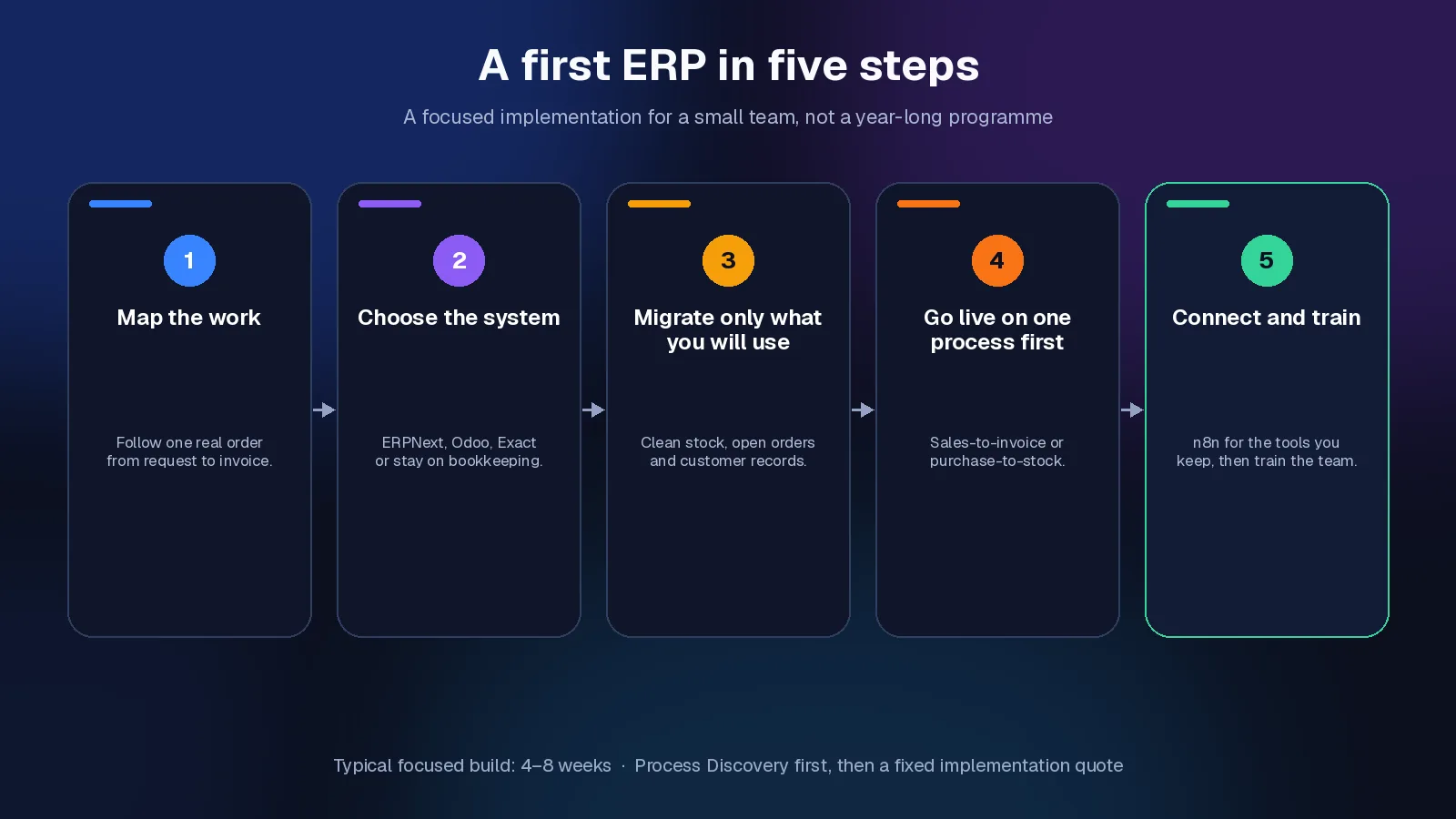
A five-step plan to start
- Map how a real order moves. Sit with the people who do the work and follow one recent job from request to invoice, including the messages and sheets they actually use. That is the core of a Process Discovery, and it is where you decide whether you need an ERP at all.
- Choose the system, and what you will keep. Exact, Odoo, ERPNext, or bookkeeping plus a CRM, should be compared against that map, not a feature matrix. Keep the tools that already work and plan the joins.
- Migrate only the data you will use. Current stock, open orders, living customer and supplier records, and the product list you actually sell. Archive the rest. Dirty data in a new ERP is still dirty data.
- Go live on one process first. Sales-to-invoice or purchase-to-stock, with a short parallel run if you need a safety net. Do not switch the whole company off on a Friday and hope.
- Connect the rest and train the team. n8n is how I attach the tools you are not replacing: a webshop, a mailbox, a shipping provider, a Telegram alert, the accountant’s export. Train the people who will click the buttons, not only the manager who signed the quote. A focused build usually takes 4–8 weeks.
How n8n fits next to an ERP
A first ERP should be the source of truth for orders, stock and invoices. It should not be forced to do every job in the company. The website form, the carrier, the shared inbox and the occasional spreadsheet can stay, as long as something reliable moves the data in and out. That is workflow automation, not more ERP configuration. I use n8n for those joins because you can host it in the EU, see every step, and change it without waiting on a vendor’s app marketplace. If you later replace one of those tools, the ERP stays put and only the workflow changes.
Frequently asked questions
Do I need an ERP, or just better bookkeeping?
If the pain is invoices, bank matching and BTW, start with bookkeeping. If the pain is the sales pipeline, start with a CRM. You need a first ERP when orders, stock, purchasing and invoicing have to stay in step, and they currently do not.
How much does a first ERP cost for a small Dutch team?
Split it into licence or hosting, implementation, and yearly care. Bookkeeping can be a few tens of euros a month; Exact Online Handel Essentials starts at €269 per month excl. BTW for one user; Odoo is per user; ERPNext hosting starts at US$5 a month with no per-user licence. Implementation is usually larger than the first year’s licence: mine starts from €3,950 excl. BTW after a Process Discovery from €595. Check the vendor pages below for current list prices.
How long does an implementation take?
A focused first ERP for a small team, with a clear process and reasonably clean data, usually takes 4–8 weeks in my work. Rebuilding every department at once takes much longer, which is why I do not start that way.
Can I keep my accountant’s software?
Often yes. Many teams keep Exact or another bookkeeping package for finance and run operations in ERPNext or Odoo, with a controlled export or an n8n workflow between them. Sometimes it is cleaner to move bookkeeping into the ERP as well. That choice belongs in the Process Discovery, together with your accountant.
Where is the data hosted?
It depends on the product and the plan. Odoo has a Europe region (production in France and Belgium; backup rules are changing through Q4 2026). Frappe Cloud offers regions including Frankfurt and Zurich, and ERPNext can also run on an EU server in your name. Confirm Exact’s region in their agreement, and keep the account in your company’s name.
Is e-invoicing already mandatory in the Netherlands?
It is already required when you invoice the Dutch central government, and a PDF does not count. For invoices between companies, the cabinet wants a duty from 1 July 2030 (reporting from 1 July 2031), with KOR businesses exempt. Choose software that can already send and receive e-invoices, often via Peppol, but you do not need a 2026 panic project for general B2B.
Sources
- Exact Online Boekhouden — features and prices, and Exact Online Handel — features and prices. VAT wording for Handel: “Alle prijzen zijn exclusief btw” on the Benelux Handel page. Checked 16 November 2026.
- Odoo pricing (official; currency is localised — USD figures as loaded on 16 November 2026) and KAPEO’s November 2026 euro reading of odoo.com. Odoo privacy policy for hosting regions, effective 24 September 2026.
- ERPNext pricing, Frappe Cloud shared hosting and the Frappe Cloud region list (including Frankfurt and Zurich). Checked 16 November 2026.
- Moneybird prices, checked 16 November 2026.
- Ondernemersplein: e-facturen to the government, and the cabinet announcement of 11 September 2026, “Kabinet kiest voor invoering e-facturatie en rapportage voor bedrijven”.
Rules and prices change. Check the linked sources for the current position before you decide.

Systems & Automation Specialist
Alec Asgari is a systems and automation specialist with experience in CRM implementation, workflow automation, and cross-functional process design. He writes about organizational strategy, technology, and operational execution.