Short answer: in 2026 a small business website in the Netherlands usually costs somewhere between about €1,000 and €8,000 excl. BTW to build, plus roughly €10–€15 a year for a .nl domain and anything from a few euros to a couple of hundred euros a month for hosting and care. Where you land depends on the type of site, who builds it, and how much of the content you bring. Every market figure below links to the public page it came from; I checked them on 9 November 2026.
I am Alec Asgari, a freelance web designer and developer based in Apeldoorn. I have built websites for 16 years, the last 5 of them in Dubai, and I now work with small businesses across the Netherlands and the EU. The question I hear first on almost every call is “what will this cost?”. This guide is the honest version of my answer: what the Dutch market charges, what drives the number up or down, and the costs people forget until the invoice arrives.
Website prices in the Netherlands at a glance
There is no official price list for websites, so the best you can do is compare a few independent snapshots. Three recent Dutch overviews land in a similar place:
- DeWebmaster’s price research (collected 8 October 2026) recorded the published entry prices of Dutch providers. For a business website, 17 entry prices ran from €395 to €7,500, with a median of €995. For a webshop, 18 entry prices ran from €349.99 to €12,500, with a median of €1,748. These are “from” prices; the authors note that what customers finally pay is often higher. (dewebmaster.nl)
- Digital Pandas (published 3 November 2026, excl. VAT) gives €500–€1,750 for an online business card of 1–3 pages, €1,750–€3,500 for a 5–10 page business site with a small agency, and €4,000–€8,000 with an agency that includes strategy and conversion work. (digitalpandas.nl)
- ContentVizier (prices checked 22 September 2026, excl. BTW) lists €800–€1,500 for a simple 5–8 page site from a freelancer, €1,500–€3,000 for a professional SME site from a freelancer, and €4,000–€8,000 for a professional SME site from an agency. (contentvizier.nl)
Put together, that gives a useful working table. The ranges are taken from the sources above, not invented, and they exclude 21% BTW:
| Type of site | Typical Dutch range (excl. BTW) | Source |
|---|---|---|
| One-pager / online business card (1–3 pages) | €500–€1,750 | Digital Pandas |
| Simple business site, 5–8 pages, freelancer | €800–€1,500 | ContentVizier |
| Professional SME site, freelancer | €1,500–€3,000 | ContentVizier |
| Business site 5–10 pages, small agency | €1,750–€3,500 | Digital Pandas |
| Business site with strategy and conversion work, agency | €4,000–€8,000 | Digital Pandas, ContentVizier |
| Webshop, freelancer | €2,500–€7,500 | Digital Pandas |
| Webshop, agency | €10,000–€30,000+ | Digital Pandas |
The spread is wide because “a website” is not one product. Two quotes of €2,500 can describe completely different jobs: one is five template pages with your own text pasted in, the other includes a page plan, copy support, redirects from your old site and analytics. Compare scope, not totals.
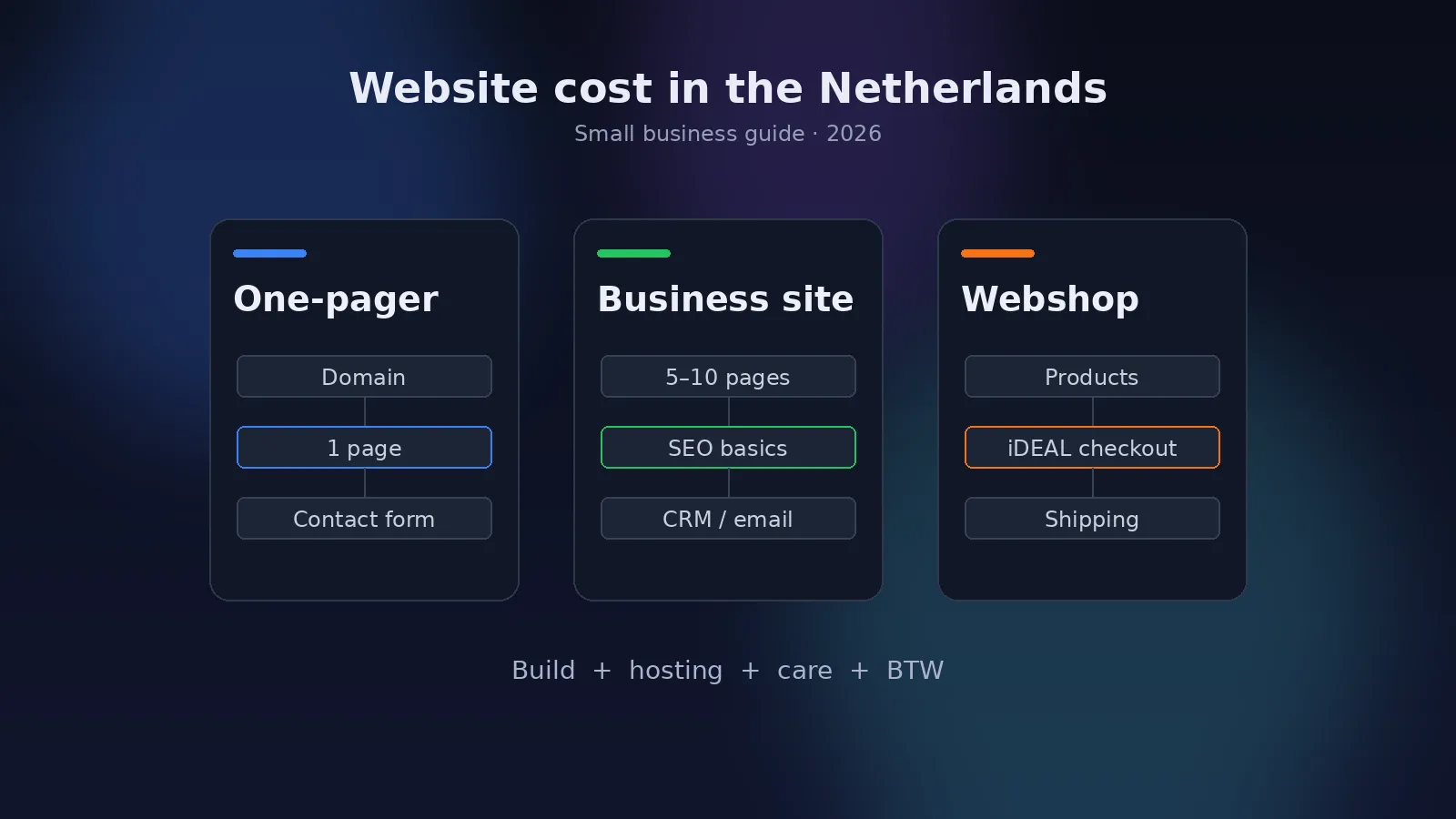
One-pager, business site or webshop?
One-pager
A single page with who you are, what you do, proof and a contact form. It suits a new zzp’er, a tradesperson who mostly gets work by phone, or a campaign. It is cheap to build and fast to launch. The limit is search: one page can only target one main topic, so it rarely brings in new customers from Google on its own.
Business site (5–10 pages)
This is what most Dutch MKB companies need: a home page, a page per main service, an about page, a contact page, and often a few location or case pages. Each service page can rank for its own searches, which is why this format is the usual choice for service businesses that want enquiries. The cost goes up with every extra page that needs its own design, text and SEO work.
Webshop
A shop is a different project. You need product data, a checkout, payment methods, shipping rules, emails, terms and conditions, and someone who keeps the catalogue up to date. That is why the ranges above jump. The platform matters too: a hosted shop system has a monthly subscription, while a self-hosted shop moves that cost to hosting and maintenance.
What drives the price up (or down)
Most website quotes are hours multiplied by a rate. Digital Pandas puts the average Dutch self-employed web developer at around €73 per hour excl. VAT in 2026 and agencies often at €75–€125 per hour, and estimates 40 to 80 working hours for a simple 5–8 page business site (source). The things that add hours:
- Custom design vs a template. Adjusting an existing theme is quicker than designing from scratch. Many small businesses do not need a unique design system, but they do need a layout that fits how they sell.
- Who writes the copy. This is the most forgotten line item. If the quote says “content supplied by client” and the content never arrives, the project stalls. DeWebmaster’s research found a median of €200 per page for outsourced web copy (source).
- Photos and branding. Your own photos, stock images or a photographer. No logo yet? Budget for it separately.
- Languages. A Dutch and an English version is roughly two sets of text, titles and checks, not a switch.
- Integrations. A form that only emails you is simple. A form that creates a CRM record, books an appointment or sends a Telegram alert is extra scope.
- Migration from an old site. Mapping old URLs to new ones with permanent redirects protects the Google visibility you already have. If it is not in the quote, ask.
- Feedback rounds. An unlimited number of revision rounds sounds generous, but it is also how projects drift. Clear rounds keep the price and the calendar honest.
Yearly costs: domain, hosting and maintenance
The build is a one-off. A website keeps costing a little every year, and those costs are where cheap offers often recover their margin. Typical recurring items, with sources:
| Item | Typical cost | Source |
|---|---|---|
| .nl domain | Often €10–€15 per year (SIDN charges registrars €4.38 per year in 2026; the registrar adds its own margin) | Digital Pandas |
| Hosting | Median €8.76/month after promotional pricing (16 Dutch hosts) | DeWebmaster |
| Maintenance without hosting | Median €29.95/month (9 prices) | DeWebmaster |
| Maintenance with hosting | Median €89/month (4 prices) | DeWebmaster |
| Hosting and maintenance combined | Roughly €20–€200/month depending on what is included | Digital Pandas |
Two practical points. First, check whether “maintenance” includes small content changes or only software updates; a low monthly price usually means changes are billed separately. Second, look at the total over three years, not the build price alone. A cheap build with poorly arranged hosting can cost more over that period than a higher quote where hosting and care are clear.
Freelancer, agency or DIY website builder?
DIY builder
Building it yourself on a website builder costs only the subscription; ContentVizier lists €12–€49 per month for Wix or WordPress (source), and Digital Pandas estimates €60–€700 in the first year excluding your own hours. It is a sensible start if you need a simple presence and enjoy doing it. The real price is your time, and the part that usually goes wrong is not design but structure: pages that do not answer what customers search for.
Freelancer
You talk to the person who builds the site, decisions are quick, and the rate is often lower than an agency’s. The fair question to ask any freelancer, including me, is what happens during illness or holidays, and who owns the accounts if you part ways. Make sure the domain, hosting and code are in your name.
Agency
Strategy, design, copywriting and SEO under one roof, with more people involved and a higher price. Worth it when you need brand work, a large site or several specialists at once. For a 5–10 page site with a clear offer, it is often more than a small business needs.
Dutch specifics that affect your budget
BTW (VAT) at 21%
Web design falls under the general Dutch VAT rate of 21% (Belastingdienst). Most business quotes are excl. BTW, but not all of them say so: DeWebmaster found that only 6 of 17 providers with a one-off website price state whether it includes or excludes VAT. Always ask. If you are VAT-registered you can usually reclaim it. If you use the small business scheme (KOR, turnover up to €20,000 per year), you do not charge VAT and you also cannot reclaim the VAT on your website (Belastingdienst, KOR), so the 21% is a real cost for you.
KVK and required business details
KVK states that your KVK number must appear on your website, as well as on letters, quotes, invoices and business email (KVK). If you provide services or sell online, the ACM also lists your registered name, address, email, phone number and VAT number as information consumers must be able to find easily (ACM). This costs nothing extra if it is planned into the footer and contact page from the start.
GDPR (AVG) and cookie consent
If your site uses tracking cookies, the Autoriteit Persoonsgegevens requires prior, informed and freely given consent: no pre-ticked boxes, accept and refuse on the same layer, and withdrawing consent as easy as giving it (AP cookie banner rules). You also need a privacy statement. A properly configured consent setup is a few hours of work; a banner that loads analytics before anyone clicks is a risk you do not want to save money on.
iDEAL for webshops
Dutch shoppers expect iDEAL (now branded iDEAL | Wero) at checkout. Payment providers charge per transaction; Mollie, for example, lists €0.32 per iDEAL | Wero payment in the Netherlands with no fixed monthly fee (Mollie pricing). For a €25 order that is about 1.3% of revenue; for a €150 order it is negligible. Card payments and pay-later methods cost more, so model your average order value before you choose which methods to offer.
Accessibility for shops
Since 28 June 2025 the European Accessibility Act applies to many online shops selling to consumers. Digital Pandas summarises that micro-businesses are excluded, but larger ones must make the shop digitally accessible (source). Even when it does not formally apply, good contrast, keyboard navigation and clear forms help every visitor.
Hidden costs to check in every quote
- Is the price excl. or incl. 21% BTW?
- How many pages, design variants and revision rounds are included?
- Who writes the text and who supplies the photos?
- Are redirects from your old site included?
- Are premium themes or plugins licensed once, or do they renew every year?
- What does a change after launch cost, per hour or per request?
- Who owns the domain, the hosting account and the code?
- Is professional email part of the offer, or a separate subscription per user?
- What is the notice period if the site is on a subscription?
What a website costs with me
My prices are starting-from amounts, excl. BTW, and every project gets a written quote after a short call, before any design work starts:
- SME Website: from €1,950 excl. BTW. A 5–7 page site, typically live in 1–2 weeks once the page list is agreed and your text and photos are ready. Custom design, a fast static build, technical SEO, analytics with cookie consent, and a contact form connected to your email or CRM. See web design and development for what is included.
- Site Care: from €79/month excl. BTW. Hosting on a fast global network, security and content updates, and a monthly traffic and leads report. It is optional.
- Webshops and integrations: quoted after a call, because the catalogue, payment methods and shipping rules decide the scope. If the form should feed a CRM or trigger a workflow, see n8n automation.
The work runs in English. The site can be fully in Dutch: you supply the Dutch copy or approve a draft before it goes live. I am on-site in Apeldoorn and elsewhere in Gelderland (see web design in Apeldoorn), and remote across the rest of the Netherlands and the EU.
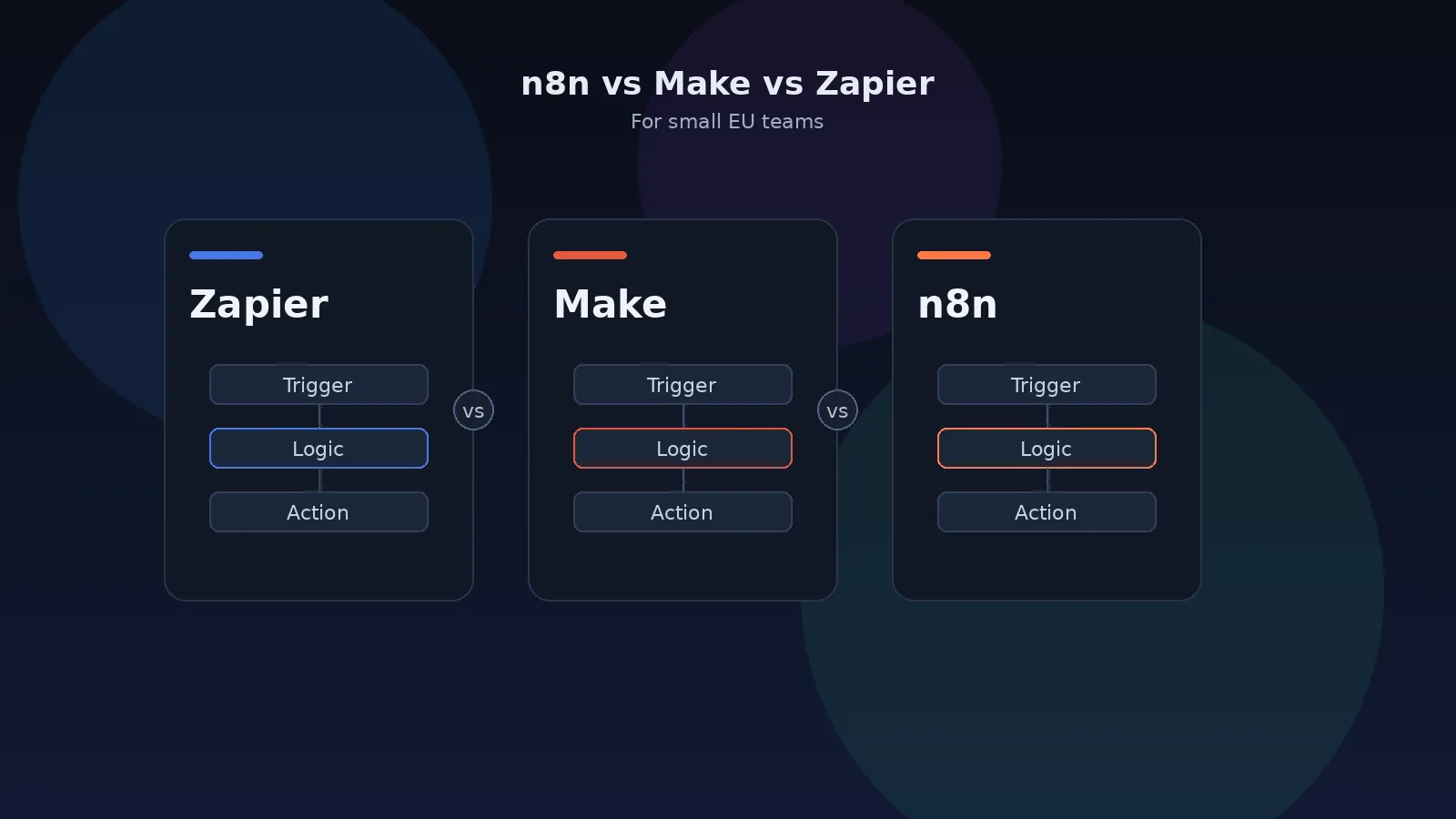
If your website is one piece of a bigger software budget, with CRM, email, marketing and automation subscriptions around it, the free SaaS cost calculator shows what that stack costs per year for a small team. When the next step is connecting the site to other tools, the n8n vs Make vs Zapier comparison explains which automation tool fits.
Want a number for your own site? Book a free 20-minute call or send a short description through the contact form: what you sell, how many pages you think you need, and what you can supply yourself.
Frequently asked questions
How much does a small business website cost in the Netherlands in 2026?
Most small business sites fall between about €1,000 and €8,000 excl. BTW to build. DeWebmaster’s October 2026 research found a median published entry price of €995 for a business website, while 2026 guides put a 5–10 page site with a small agency at €1,750–€3,500 and a strategy-led agency project at €4,000–€8,000. Add hosting, a domain and maintenance every year.
What does a website cost per year after launch?
A .nl domain is often €10–€15 per year. Hosting had a median of €8.76 per month after promotions in DeWebmaster’s research, and maintenance a median of €29.95 per month without hosting or €89 with hosting. Depending on what is included, hosting and care together usually run from about €20 to €200 per month.
Are website prices in the Netherlands quoted with or without BTW?
Business quotes are usually excl. BTW, but many providers do not say so. Ask every time. The general Dutch VAT rate of 21% applies to web design. If you use the small business scheme (KOR), you cannot reclaim that VAT, so it is a real cost.
Is a freelancer cheaper than an agency for a website?
Usually yes for the same scope, because freelancers have less overhead. Published 2026 ranges put a professional SME site at €1,500–€3,000 with a freelancer and €4,000–€8,000 with an agency. Check continuity and ownership: who covers illness or holidays, and whether the domain, hosting and code are in your name.
What does a webshop cost in the Netherlands?
Published ranges for 2026 are €2,500–€7,500 with a freelancer and €10,000–€30,000 or more with an agency. On top of that come platform or hosting costs and payment fees per transaction, such as €0.32 per iDEAL | Wero payment at Mollie. The catalogue size, payment methods and shipping rules drive the build price.
What must a Dutch business website show by law?
Your KVK number, and when you provide services or sell online also your registered business name, address, email, phone number and VAT number. If you use tracking cookies, you need prior consent through a clear cookie banner and a privacy statement. Check the KVK, ACM and Autoriteit Persoonsgegevens pages for your situation.

Systems & Automation Specialist
Alec Asgari is a systems and automation specialist with experience in CRM implementation, workflow automation, and cross-functional process design. He writes about organizational strategy, technology, and operational execution.